
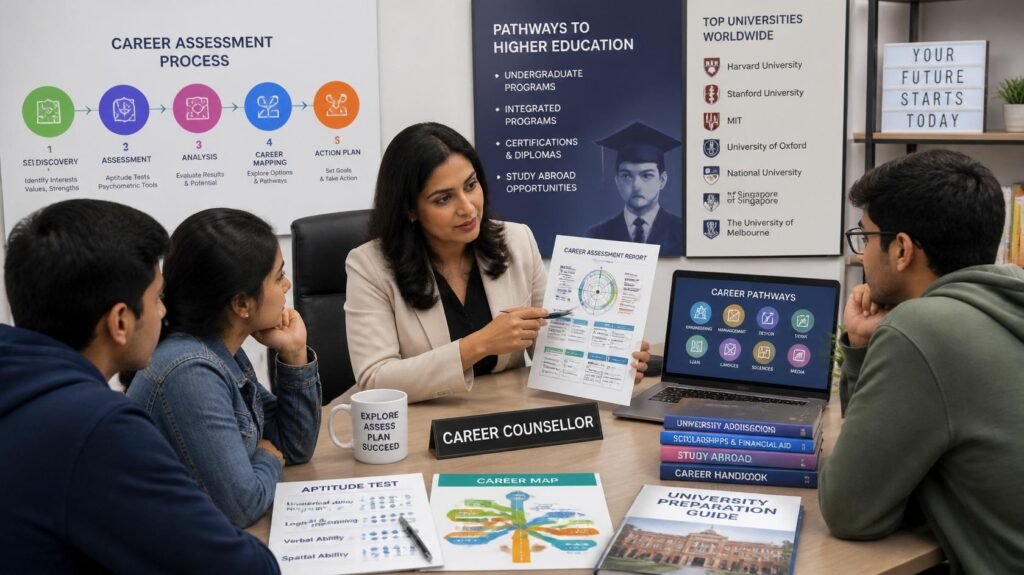
Choosing a stream after school is easy compared to what comes next — deciding what to study after graduation, which entrance exam to prepare for, or whether a niche specialization is worth the risk. This is exactly where a career track assessment for college going students becomes a turning point rather than just another test. It doesn’t hand out a single “correct” answer; instead, it maps a student’s aptitude, interests, and personality against real-world academic and career pathways, so that the leap into higher studies is backed by evidence, not guesswork. At Tera Parichay, we’ve seen how this one step can quietly reshape a student’s entire trajectory — for the better.
The Confusion before Higher Studies Begins
Most college students don’t lack ambition — they lack clarity. They’re surrounded by opinions: what their parents did, what their friends are choosing, what looks impressive on LinkedIn. Somewhere in that noise, their own strengths get buried. A structured assessment cuts through this by replacing assumptions with data, helping students see themselves objectively before they commit years and money to a postgraduate path.
Why Aptitude Matters More Than Interest Alone
Interest tells you what excites a student today; aptitude tells you what they can sustain for the next ten years. A student may love the idea of finance but struggle with the analytical grind it demands, or assume they’re “not a science person” without ever testing their actual reasoning ability. Career track assessments measure both dimensions together — cognitive aptitude and genuine interest — so the recommendation isn’t just exciting on paper but realistic in practice.
Turning Abstract Strengths into a Concrete Academic Plan
It’s one thing to know a student is “good with numbers” — it’s another to translate that into an actual decision between an MBA, a CFA, actuarial science, or a data analytics postgraduate program. This translation is where most students get stuck. A good assessment doesn’t stop at identifying strengths; it connects those strengths to specific degree programs, specializations, and even the entrance exams or eligibility criteria a student should start preparing for.
Reducing the Cost of Wrong Choices
Higher education is expensive — in tuition, time, and opportunity cost. A wrong postgraduate choice doesn’t just waste a year; it often means starting over. Assessments act as a filter before the financial and emotional investment is made, flagging mismatches early. Some of the risks a timely assessment helps students avoid include:
- Enrolling in a postgraduate course chosen purely for its “market demand” rather than personal fit
- Discovering mid-course that the subject matter clashes with their natural working style
- Investing in expensive entrance exam coaching for a field they were never suited to
- Following a peer group into the same program without evaluating individual strengths
Building Self-Awareness That Outlasts the Assessment Itself
The real value of an assessment isn’t the report it generates — it’s the vocabulary it gives students to describe themselves. Once a student understands whether they’re naturally analytical, people-oriented, creative, or systems-driven, they carry that self-awareness into internship choices, elective subjects, and even interview conversations years later. This is a skill, not a one-time output.
Aligning Higher Studies with Long-Term Career Outcomes
Higher studies should never be chosen in isolation from the career they lead to. A well-designed career track assessment for college going students works backward from real career outcomes, showing students which postgraduate routes actually open doors in their field of interest, and which ones sound prestigious but offer limited practical returns. This outcome-first approach is what separates a meaningful assessment from a generic personality quiz.
Helping Parents and Students Reach Common Ground
A recurring source of stress for college students is disagreement with parents over “practical” versus “passion-driven” choices. When an assessment is involved, the conversation shifts from opinion versus opinion to data versus opinion. Parents tend to trust structured, professionally designed results more than a teenager’s verbal argument, which makes the assessment a genuine bridge between generations rather than a source of further conflict.
What a Good Assessment Actually Evaluates
Not all assessments are created equal, and students should know what to look for before trusting one with a major life decision. A credible career track assessment typically evaluates:
- Logical, numerical, and verbal reasoning ability
- Personality traits and preferred working styles
- Interest patterns across academic and professional domains
- Emotional intelligence and decision-making tendencies
- Compatibility with specific postgraduate streams and career families
Assessments that skip most of these and rely only on a short interest quiz tend to produce shallow, forgettable results.
Why This Should Be a Priority, Not an Afterthought
Many students only consider structured guidance after they’ve already stumbled — after a semester of regret or a program that didn’t fit. The smarter approach is proactive, not reactive. This is a big part of why every college student should invest in career counselling well before final-year panic sets in, rather than treating it as a last resort when options have already narrowed. Early clarity simply gives students more room to plan, prepare, and pivot if needed.
Making the Assessment Work: The Follow-Through Matters
An assessment is only as useful as the action taken after it. Students who treat the report as a conversation starter — discussing results with mentors, researching recommended programs, and revisiting the findings as they gather more real-world experience — get far more value than those who file it away and forget it. Tera Parichay’s approach is built around this follow-through, pairing every assessment with guidance that helps students actually act on what they’ve discovered, so that the path to higher studies feels less like a gamble and more like a plan they’ve genuinely chosen for themselves.